Tale Album
Sign inTurn a story into a picture-story book.
A writing-table tool for parents, grandparents, teachers — and anyone with a story worth printing.
Make your first book, freeFrom these books
How it works
What you paste
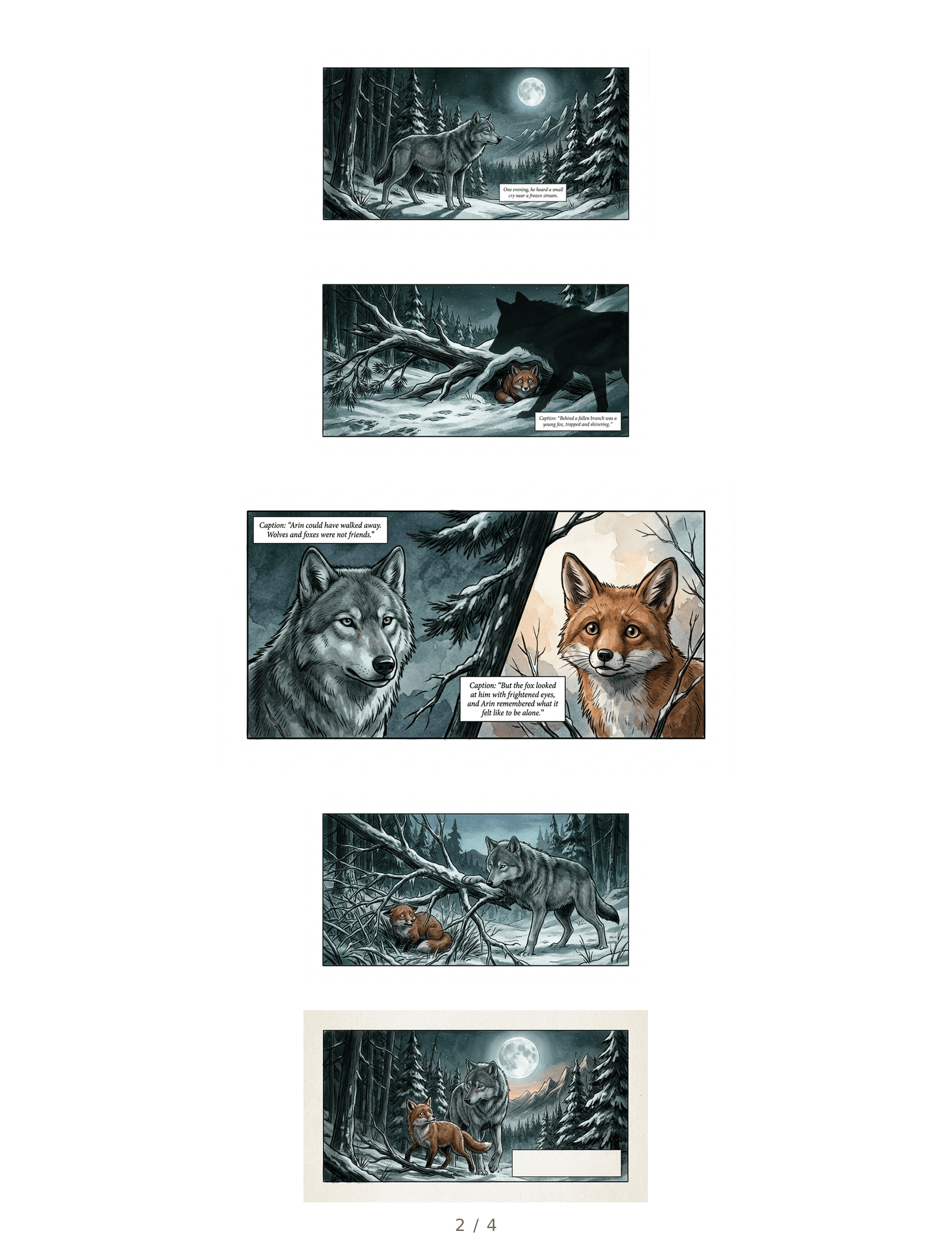
The wolf walked alone under the silver moon. His name was Arin, and he lived in the dark pine forest beyond the mountains. Every night, he listened to the wind, the owls, and the distant river. But more than anything, he listened for his pack.
…268 words in all
What you get
We’ll pre-fill it — edit a line, or swap in your own.
Transcribe
Paste a story or drop a scan of a kid's handwritten page. We read it, in any language.
Propose
A page count, a style, a cast of characters, a setting. Editable before you commit a single image-gen call.
Render
Every panel as illustration. Composed into pages with title banners and page numbers, exportable as PDF.
Your first book, on us
Sign in with your email, make one complete picture-story book — free, no card, no catch.
We’re still early, so it’s one book per person while we find our feet. Start yours — or email beta@talealbum.com if you want to make more.
Questions
- What can I turn into a comic book?
- A letter, a diary entry, a short story, or a child's own writing. Paste the text, or photograph a handwritten page and it is read for you.
- Can the same characters appear across several books?
- Yes. A book can continue an earlier one, and the characters keep their faces: the portraits are copied from the previous part rather than drawn again, so a face cannot drift between books and the continuation costs nothing extra for the characters it reuses.
- What size can I print it at?
- Pages are composed 1600 pixels across in A-series proportions. That is about 387 DPI at A6 and 275 DPI at A5, both good print quality, and about 194 DPI at A4, which is noticeably softer. A5 and A6 are the sizes to aim for.
- Can I choose how it looks?
- Yes. Eleven visual languages are available, from storybook watercolour and loose ink line through manga, noir and painted realism. The more a style abstracts faces, the less a specific likeness survives it, so a newspaper-strip look will not carry a particular child's face.
- Does it work in languages other than English?
- Yes. The source language is detected, and text typed without diacritics has its accents restored — a Slovak story typed on a plain keyboard comes back correctly accented, with the writer's own words otherwise untouched.
- What does it cost?
- The first book is free during the open beta. Each illustration is generated on demand, and spending is capped so a book cannot run away with the bill.